




Investments
Market Review: August 2008 Commentary
Thursday 7th of August 2008
In this Tyndall Comment, we point to economic troubles in the U.S. and the Euro zone. Unlike in the US, policymakers in Europe are speeding their economies into contraction. With many of the world economies recession-bound, there are implications for New Zealand - our currency, farm incomes, inflationary pressures and interest rate. Substantial further interest rate cuts and a partial recovery in our asset markets are now distinct possibilities. Greg Campbell, Managing Director, Tyndall
So the Reserve Bank of New Zealand (RBNZ) decided to go early and cut the official cash rate (OCR) now, rather than wait until September. The reduction of the OCR from 8.25% to 8.00% is a positive move for the rapidly weakening New Zealand economy and represents the first OCR reduction since 24 July 2003 – exactly five years to the day from this latest cut. It also marks the start of an easing monetary cycle, of which it is anyone's guess how long it continues for and how large the reduction in the OCR becomes. The July 24 OCR announcement was one of the most eagerly anticipated for quite some time. There was genuine uncertainty about whether the RBNZ would be bold enough to go ahead and cut (although most felt it was the right thing to do) or to wait until it had even more data (particularly early August's Household Labour Force Survey) and cut at the next announcement, on September 11. The question now is will the RBNZ cut again this year? After September, there are two announcement dates in the final quarter of 2008 – October 23 and December 4. At this stage, there could well be a further cut (maybe another 0.25%, maybe even 0.50% if things are not looking particularly good) on at least one of those three dates. Of course, the RBNZ does not have to wait until a scheduled announcement date to make a change. However, only once in its history has it altered the OCR outside of the eight scheduled announcement dates each year and that was after September 11, 2001. This year, though, we have already seen the US Federal Reserve's Open Market Committee make a surprise 0.75% cut to the Fed Funds rate in January, just over a week before making another 0.50% cut at its scheduled January announcement. So, with the current difficult (read: expensive) environment for credit, the RBNZ has at least a global precedent if it wanted to move on its own accord. The main factors influencing the RBNZ's decisions on whether to cut are:
- the deteriorating economy
- the level of inflation
- the level of the NZD
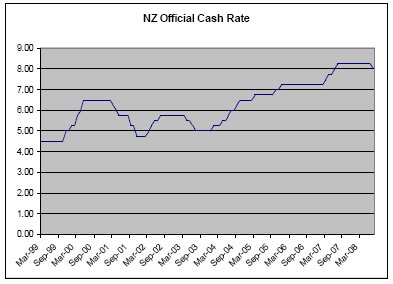 Both of these easing "programmes" only lasted a matter of months and in both cases saw the OCR lifted again six months later. However, with the OCR level at 8%, we are in uncharted territory. Combine that with New Zealand possibly being in a technical recession (two consecutive quarters of negative GDP), massive falls in the New Zealand sharemarket and the housing market, yet counterbalanced by a very high NZD and the highest inflation level since a brief spike in 1995 and the picture becomes more complicated.
The RBNZ has traditionally been seen as being "hawkish" (quick to raise rates but not so keen to lower them). The current scenario of the RBNZ needing to reduce interest rates to 6.0–6.5% over the next year to 18 months has now become a distinct possibility.
Peter Lynn, CFA,Head of Strategy
Both of these easing "programmes" only lasted a matter of months and in both cases saw the OCR lifted again six months later. However, with the OCR level at 8%, we are in uncharted territory. Combine that with New Zealand possibly being in a technical recession (two consecutive quarters of negative GDP), massive falls in the New Zealand sharemarket and the housing market, yet counterbalanced by a very high NZD and the highest inflation level since a brief spike in 1995 and the picture becomes more complicated.
The RBNZ has traditionally been seen as being "hawkish" (quick to raise rates but not so keen to lower them). The current scenario of the RBNZ needing to reduce interest rates to 6.0–6.5% over the next year to 18 months has now become a distinct possibility.
Peter Lynn, CFA,Head of Strategy
Want to read the full article?
Click the button below to subscribe and will have free unlimited access for a limited time to full article and all other articles on the site.
You will also be able to comment on articles on Good Returns.
Latest News


![[The Wrap] What the heck is happening at the FMA?](https://goodreturns.publit.io/file/c_fill,w_300,h_200/a6c3bc06-6401-44de-96e2-286c090e132d.jpg)