



Market Review: June 2009 Commentary
The Rally Continues
As May ended, the sharemarkets completed their third consecutive positive month in a row. Since March 3, the NZX 50 Index is up 17.5% to the end of the past month. There hasn't been a three month rally (using full calendar months) of this magnitude since the three months ended January 1999 - over 10 years ago!
The same thing has happened on the global stage, although on an even bigger scale. The MSCI World Index (in local currency terms) is up 34.2% from its March 9 bottom to the end of May. There hasn't been a three month period of this magnitude (either positive or negative) in the 40-year history of this index.
Unfortunately for New Zealand investors in global equities, unless you were hedged, you have not reaped the full benefits (or even many of the benefits) of this large global rise, as the NZD has risen in concert. The NZD has been the strongest currency in the world over the past three months, rising against every one of the 16 other most traded currencies over that period.
The biggest rise has been against the weak USD, where the NZD fell to USD 0.4927 on March 2, but then rallied strongly to USD 0.6405 on May 31, or a 30% rise.
To put this NZD rise into perspective, compare the local currency MSCI World Index return of 34.2% quoted above (from March 9 to May 31), with the NZD unhedged MSCI World Index return over that same period. It was only 10.3% -- still good, but significantly reduced by the currency effect.
This NZD rise is not sustainable. Since the end of May, the NZD has continued to push up to close to USD 0.6600, which is the same level it was at in September 2008, before the OCR cuts saw it plummet away into the 0.5000's. It is, again, causing significant angst for exporters and is certainly not what the RBNZ wants.
Dairy farmers, already seeing a much reduced 2009 payout are getting a double whammy as the relatively high NZD further reduces the NZD value of their milk production. There could well be further falls in this payout level, which, as the media has pointed out, has sizeable effects on the whole New Zealand economy. I expect the NZD to fall away from these high levels.
If it doesn't, the RBNZ could well intervene to force it down. In a global game of having reduced currencies, New Zealand is the biggest loser so far, despite making tremendous strides over the previous six months.
Turning back to the New Zealand sharemarket, it is interesting to see if this pattern of a large rise immediately following a large fall is par for the course.
Although we all know that what happened in the past almost never recurs exactly the same in the future and is, at best, only a weak guide to future patterns, looking at past New Zealand sharemarket shocks of a similar magnitude to those suffered in the current economic environment may help us better understand what the future could hold. At the very least, it provides a perspective.
Below is a table showing the five largest "drawdown" periods for the New Zealand sharemarket from my data (which goes back to 1931). A drawdown is the period from the top to the bottom of a cycle.
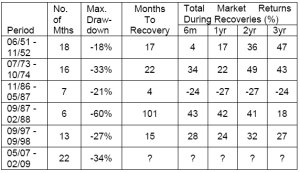
The "Months to Recovery" column represents the number of months it took to regain all losses. The total recovery returns for two and three years are unannualised, cumulative returns. All data is based on full calendar months.
There are several interesting features of this table, including the following:
· New Zealand has not really had a lot of crashes in the nearly 80 years of history;
· The majority of the crashes have occurred in the past 25 years;
· Unlike the rest of the world, we never had a crash during the early part of this decade (the bursting of the tech bubble), which had global drawdowns of nearly the same magnitude (or, in Europe's case, even more) than the 07-09 financial crisis;
Click the button below to subscribe and will have free unlimited access for a limited time to full article and all other articles on the site.
You will also be able to comment on articles on Good Returns.


![[The Wrap] What the heck is happening at the FMA?](https://goodreturns.publit.io/file/c_fill,w_300,h_200/a6c3bc06-6401-44de-96e2-286c090e132d.jpg)