




Market Review: March 2008 commentary
February started off and, indeed, carried on in a
similar vein to January, although, fortunately, not of
the same magnitude. The first half of the month
basically resulted in steadily declining global
sharemarkets, as economic data from the US, in
particular, was predominantly weak. In addition,
inflation concerns seem to be back in the US,
especially as the Fed is clearly targeting an
attempted reacceleration of economic
growth as its main priority. The markets
are becoming more used to some relatively
poor economic news as the US economy
continues to slow down.
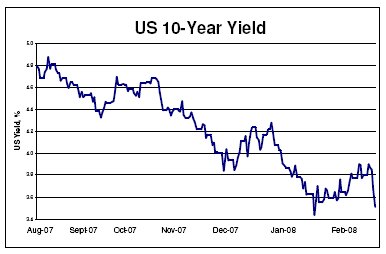
Global bond markets continued their
downward trend. The chart below shows
the steady fall in the US 10-year yield over
the last seven months, including the
amount of volatility over the last three months. It
has certainly been a large fall.
 After a weak first half of the month, the US market
turned around and bounced back strongly, with
other bourses following suit.
The latter part of the month
tended to be a general
decline, although somewhat
limited in relation to what has
been the trend over the past
15 weeks. Of note is the
strong rebound in the oil
price at the end of the month,
going over the
psychological
USD100 a barrel
mark.
The NZX followed this trend, although
its lows were not as low (and the
bouncebacks were nowhere as strong).
For example, one particularly bad day
on global markets was February 5. If
NZ had not been on holiday the next day, we would
have probably had a similar large fall to that
experienced by Australia and other markets in its
wake. Fortunately, the next day saw a recovery
and, while we didn't feature in the strong up market,
we missed the volatility that resulted on other world
markets from that activity.
It does seem like this increased volatility is going to
be around for some time. The credit crisis still has
no light at the end of its uncertainty tunnel and
markets do not like unease. As a result, company
result periods are especially nervous times.
We saw an example of this in New Zealand with
Fletcher Building. Their result was not overly
disappointing, but it was not overly encouraging,
either. The problem for the company (and its
shareholders) was that its result was released on a bad day for global sharemarkets and, because it
did not surprise on the upside, it got punished.
Is this rational? Not really, but such events happen
in times of significant volatility. So, are bargains
then created through this irrationality? Undoubtedly
and if you happen to glance back at market history
in a couple of years' time, you may well be shaking
your head and saying why did I not purchase XYZ,
Inc. at that time.
It is not that straight forward, however. Some
purchases made now may take a very long time to
realise their value, while others may well fall even
further and be much cheaper next week.
This is the time when active managers really earn
their stripes. Good fundamental research will find
those companies that provide the strongest value
over the long term. During the years
2003-2006 (inclusive), the very strong
markets were driven by a lot of
corporate activity. In many cases, low
quality companies were being acquired
because their managements had not
been efficient and their share prices had
not risen as expected (and they were
thus "cheap"). The hint of a takeover
saw these share prices then rise very
strongly. As a result, lower quality
companies performed better than higher
quality companies. However, a down
market will tend to show the opposite
effect, with strong companies
significantly outperforming the weaker
companies.
So, with two months of incredible headwinds
already suffered on world markets, what are
expectations for returns over the whole 2008 year?
If only we knew, but we will take the liberty of
making some predictions. We will start with the
easiest sector to make some type of estimate.
We do not believe that the RBNZ will raise interest
rates further in 2008, given the weakening domestic
economy and the significant slowdown we are
witnessing in the housing market. However, it is
not likely to lower rates, either, this year, as inflation
concerns are still amplified. Hence, cash should be
one of the strongest performers in 2008, with such
a high Official Cash Rate available at no risk.
Hence returns are likely to be around the 8.25%-
8.5% level for an investment in 90-day bank bills.
The bond markets may well be a mixture of
government bonds offering a haven (and hence a
relatively strong performance) and corporate credit
spreads remaining stubbornly wide (although with a
large amount of volatility). The latter reflects the
continued uncertainty in credit markets and the
strong feeling that there is still some more pain to
come. Domestically, we are still seeing finance
companies struggling, with MFS Boston the latest
to fall over. All up, there seems little prospect
anything too much higher than low single digit
returns from a portfolio of predominantly corporate
credits in 2008.
A global bond portfolio may perform somewhat
better if hedged into NZD, as the still weakening US
dollar and the low likelihood of RBNZ rate cuts
means that the NZD is expected to remain high
throughout the year. Currently, this premium is
delivering over 5% p.a. as a risk-free benefit to a
global bond portfolio over a corresponding
domestic portfolio. While global corporate credits
are possibly going to continue to struggle against
the uncertainty, global sovereigns, led by the US
Fed, are expected to continue on an easing bias to
add stimulus to weakening economies. (The RBA
may be a near term exception to this trend.)
However, it is the equity markets that
will likely exhibit the most interest.
Both domestic and global markets
have fallen so far this year that we
give them very little chance of
recovering those losses completely
over the final eight months of 2008.
There is also likely to be the large
amount of continued volatility
exhibited for probably the next six
months, where markets can go up or
down by 1% or more on any day.
We do believe that the market low
experienced in mid-January will serve
as the low for the year. Note, though, that this low
could be tested several times over remaining
months of 2008.
However, there could well be a temporary positive
spell for the US sharemarkets (and hence the
world's markets) after Easter. If the Fed lowers
rates further (and there is a very strong chance
they will), then this could provide a temporary
stimulus that could well see the markets have a
relatively strong few months on the back of this.
The fundamental expectation, though, is that
economies are weak (or in recession) and with the
US housing market continuing to sell off, resulting
in severely weakening consumer confidence,
corporate profits are likely to be well lower than the
levels they have been at over the past few years.
We may have to wait until early 2009 before the
general uncertainty subsides and we can look
forward to stronger valuations, higher share prices
and a resumption of merger and acquisition activity.
With a strong level of confidence, we predict that
markets this time next year will be at higher levels
than they are at the end of February 2008.
After a weak first half of the month, the US market
turned around and bounced back strongly, with
other bourses following suit.
The latter part of the month
tended to be a general
decline, although somewhat
limited in relation to what has
been the trend over the past
15 weeks. Of note is the
strong rebound in the oil
price at the end of the month,
going over the
psychological
USD100 a barrel
mark.
The NZX followed this trend, although
its lows were not as low (and the
bouncebacks were nowhere as strong).
For example, one particularly bad day
on global markets was February 5. If
NZ had not been on holiday the next day, we would
have probably had a similar large fall to that
experienced by Australia and other markets in its
wake. Fortunately, the next day saw a recovery
and, while we didn't feature in the strong up market,
we missed the volatility that resulted on other world
markets from that activity.
It does seem like this increased volatility is going to
be around for some time. The credit crisis still has
no light at the end of its uncertainty tunnel and
markets do not like unease. As a result, company
result periods are especially nervous times.
We saw an example of this in New Zealand with
Fletcher Building. Their result was not overly
disappointing, but it was not overly encouraging,
either. The problem for the company (and its
shareholders) was that its result was released on a bad day for global sharemarkets and, because it
did not surprise on the upside, it got punished.
Is this rational? Not really, but such events happen
in times of significant volatility. So, are bargains
then created through this irrationality? Undoubtedly
and if you happen to glance back at market history
in a couple of years' time, you may well be shaking
your head and saying why did I not purchase XYZ,
Inc. at that time.
It is not that straight forward, however. Some
purchases made now may take a very long time to
realise their value, while others may well fall even
further and be much cheaper next week.
This is the time when active managers really earn
their stripes. Good fundamental research will find
those companies that provide the strongest value
over the long term. During the years
2003-2006 (inclusive), the very strong
markets were driven by a lot of
corporate activity. In many cases, low
quality companies were being acquired
because their managements had not
been efficient and their share prices had
not risen as expected (and they were
thus "cheap"). The hint of a takeover
saw these share prices then rise very
strongly. As a result, lower quality
companies performed better than higher
quality companies. However, a down
market will tend to show the opposite
effect, with strong companies
significantly outperforming the weaker
companies.
So, with two months of incredible headwinds
already suffered on world markets, what are
expectations for returns over the whole 2008 year?
If only we knew, but we will take the liberty of
making some predictions. We will start with the
easiest sector to make some type of estimate.
We do not believe that the RBNZ will raise interest
rates further in 2008, given the weakening domestic
economy and the significant slowdown we are
witnessing in the housing market. However, it is
not likely to lower rates, either, this year, as inflation
concerns are still amplified. Hence, cash should be
one of the strongest performers in 2008, with such
a high Official Cash Rate available at no risk.
Hence returns are likely to be around the 8.25%-
8.5% level for an investment in 90-day bank bills.
The bond markets may well be a mixture of
government bonds offering a haven (and hence a
relatively strong performance) and corporate credit
spreads remaining stubbornly wide (although with a
large amount of volatility). The latter reflects the
continued uncertainty in credit markets and the
strong feeling that there is still some more pain to
come. Domestically, we are still seeing finance
companies struggling, with MFS Boston the latest
to fall over. All up, there seems little prospect
anything too much higher than low single digit
returns from a portfolio of predominantly corporate
credits in 2008.
A global bond portfolio may perform somewhat
better if hedged into NZD, as the still weakening US
dollar and the low likelihood of RBNZ rate cuts
means that the NZD is expected to remain high
throughout the year. Currently, this premium is
delivering over 5% p.a. as a risk-free benefit to a
global bond portfolio over a corresponding
domestic portfolio. While global corporate credits
are possibly going to continue to struggle against
the uncertainty, global sovereigns, led by the US
Fed, are expected to continue on an easing bias to
add stimulus to weakening economies. (The RBA
may be a near term exception to this trend.)
However, it is the equity markets that
will likely exhibit the most interest.
Both domestic and global markets
have fallen so far this year that we
give them very little chance of
recovering those losses completely
over the final eight months of 2008.
There is also likely to be the large
amount of continued volatility
exhibited for probably the next six
months, where markets can go up or
down by 1% or more on any day.
We do believe that the market low
experienced in mid-January will serve
as the low for the year. Note, though, that this low
could be tested several times over remaining
months of 2008.
However, there could well be a temporary positive
spell for the US sharemarkets (and hence the
world's markets) after Easter. If the Fed lowers
rates further (and there is a very strong chance
they will), then this could provide a temporary
stimulus that could well see the markets have a
relatively strong few months on the back of this.
The fundamental expectation, though, is that
economies are weak (or in recession) and with the
US housing market continuing to sell off, resulting
in severely weakening consumer confidence,
corporate profits are likely to be well lower than the
levels they have been at over the past few years.
We may have to wait until early 2009 before the
general uncertainty subsides and we can look
forward to stronger valuations, higher share prices
and a resumption of merger and acquisition activity.
With a strong level of confidence, we predict that
markets this time next year will be at higher levels
than they are at the end of February 2008.
Peter Lynn, Head of Strategy
A cautionary tale from not so sunny Spain Neither households nor businesses like the concept of higher interest rates but we suspect that many homeowners, companies and even banks in Spain now wish that the European central bank had operated a higher interest rate regime over the last 10 years. When Spain signed up for the Euro Project in the mid 1990s, many in the country (and particularly in the stock market) welcomed the implied promise of lower short term interest rates and borrowing costs that country's membership of the EMU promised. In fact, the combination of lower 'German' levels of interest rates and an initially competitive exchange rate within the fixed exchange rate regime that the Euro effectively adopted from 1996 onward provided a huge stimulus to the economy which even the global Y2K bust did little to dilute. Indeed, Spain's economic boom arguably accelerated further during the 2000s.
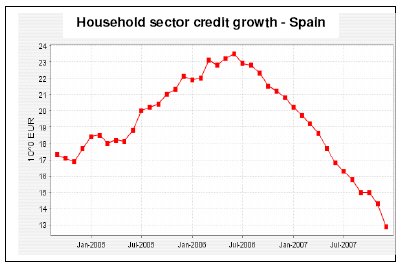 At the centre of Spain's rapid economic growth
between 2001 and 2007 was a massive credit boom
that saw the country's private sector increase its
outstanding level of borrowing by over a trillion Euros
(an amount roughly equivalent to the economy's total
GDP). In particular, both households and companies
borrowed aggressively in order to speculate in the
local property market and, with some help from
substantial inflows from both British and German
investors, the result was an obvious and fierce
property boom. However, as house prices increased,
the cost of living and working in Spain increased
sharply, with the result that there was an
understandable increase in wage inflation in the
economy as people sought 'compensation' for their
higher living costs. At the same time, so much effort
was being expended by companies and others on
speculative activities that domestic productivity
growth and perhaps even R&D suffered, with the
result that the country's initially competitive position
within the Euro System was eroded. Credit booms,
while exciting in the short term, tend to damage
competitiveness and introduce distortions into the
economies that they infect.
Indeed, as Spain entered 2007, it did so with
relatively high labour costs in comparison
to local productivity levels and a heavily
indebted private sector that had become
accustomed to spending around 110% of
every Euro that it earned. Clearly, the
situation had become unsustainable and,
as a consequence, we were not surprised
to find Spain's economy beginning to lose
momentum as 2007 progressed and the
shortcomings of the boom were revealed.
At first, this slowdown proved relatively gentle, not
least of all because companies could continue to
access credit relatively cheaply, even if this borrowing
activity had become a necessity rather than a luxury,
as developers found themselves needing to fund
rising inventories of unsold properties. Spain's
predicament worsened significantly following the
onset of the global credit market debacle in late
August. Spain's banks, like many others, found it
more difficult to raise the funding that they needed, a
situation that implied that they were forced to become
less accommodative to their own clients.
Consequently, the supply of credit to the already
troubled property market began to dry up, with the
result that forced sellers became apparent in the
property markets and prices began to tumble.
Although we have no reliable indicators of average
house prices in the economy, the fact that new
property starts are back to their 1992 levels speaks
volumes about the decline in the housing market.
Naturally, this weakness in the property market
began to affect both consumer sentiment and
solvency, with the result that retail sales growth has
now all but evaporated within the economy.
To make matters worse, as global growth has
slowed, Spain's already uncompetitive companies
also began to struggle to export and to compete with imports, particularly as the Euro appreciated. Thus,
as 2007 drew to a close, Spanish growth had begun
to slow sharply and many of those who had borrowed
aggressively during the boom were facing very
pressing cash flow problems. Unsurprisingly, the
banks began to find that many of the loans that they
had made during the boom were turning 'bad' as the
borrowers fell in difficulties and thus the economy's
problems became the banks' problems as well.
In fact, as we entered 2008, it became
apparent that Spain's banks were close to
a crisis situation; had the European
Central Bank not been prepared to lend
them tens of billions of Euro's, then bank
failures would have been very likely.
However, there are now rumours that the
global credit rating agencies are
considering a (belated) downgrading of
the Spanish banks, with the result that not
only will the banks' financial positions
become even more precarious at a fundamental
level, it may also become difficult for the ECB to lend
more money to these 'less than investment grade'
institutions. 2008 therefore promises to be a very
difficult year for Spain.
At the centre of Spain's rapid economic growth
between 2001 and 2007 was a massive credit boom
that saw the country's private sector increase its
outstanding level of borrowing by over a trillion Euros
(an amount roughly equivalent to the economy's total
GDP). In particular, both households and companies
borrowed aggressively in order to speculate in the
local property market and, with some help from
substantial inflows from both British and German
investors, the result was an obvious and fierce
property boom. However, as house prices increased,
the cost of living and working in Spain increased
sharply, with the result that there was an
understandable increase in wage inflation in the
economy as people sought 'compensation' for their
higher living costs. At the same time, so much effort
was being expended by companies and others on
speculative activities that domestic productivity
growth and perhaps even R&D suffered, with the
result that the country's initially competitive position
within the Euro System was eroded. Credit booms,
while exciting in the short term, tend to damage
competitiveness and introduce distortions into the
economies that they infect.
Indeed, as Spain entered 2007, it did so with
relatively high labour costs in comparison
to local productivity levels and a heavily
indebted private sector that had become
accustomed to spending around 110% of
every Euro that it earned. Clearly, the
situation had become unsustainable and,
as a consequence, we were not surprised
to find Spain's economy beginning to lose
momentum as 2007 progressed and the
shortcomings of the boom were revealed.
At first, this slowdown proved relatively gentle, not
least of all because companies could continue to
access credit relatively cheaply, even if this borrowing
activity had become a necessity rather than a luxury,
as developers found themselves needing to fund
rising inventories of unsold properties. Spain's
predicament worsened significantly following the
onset of the global credit market debacle in late
August. Spain's banks, like many others, found it
more difficult to raise the funding that they needed, a
situation that implied that they were forced to become
less accommodative to their own clients.
Consequently, the supply of credit to the already
troubled property market began to dry up, with the
result that forced sellers became apparent in the
property markets and prices began to tumble.
Although we have no reliable indicators of average
house prices in the economy, the fact that new
property starts are back to their 1992 levels speaks
volumes about the decline in the housing market.
Naturally, this weakness in the property market
began to affect both consumer sentiment and
solvency, with the result that retail sales growth has
now all but evaporated within the economy.
To make matters worse, as global growth has
slowed, Spain's already uncompetitive companies
also began to struggle to export and to compete with imports, particularly as the Euro appreciated. Thus,
as 2007 drew to a close, Spanish growth had begun
to slow sharply and many of those who had borrowed
aggressively during the boom were facing very
pressing cash flow problems. Unsurprisingly, the
banks began to find that many of the loans that they
had made during the boom were turning 'bad' as the
borrowers fell in difficulties and thus the economy's
problems became the banks' problems as well.
In fact, as we entered 2008, it became
apparent that Spain's banks were close to
a crisis situation; had the European
Central Bank not been prepared to lend
them tens of billions of Euro's, then bank
failures would have been very likely.
However, there are now rumours that the
global credit rating agencies are
considering a (belated) downgrading of
the Spanish banks, with the result that not
only will the banks' financial positions
become even more precarious at a fundamental
level, it may also become difficult for the ECB to lend
more money to these 'less than investment grade'
institutions. 2008 therefore promises to be a very
difficult year for Spain.
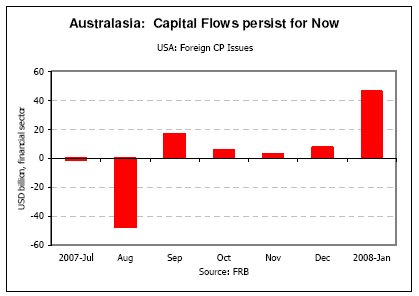 We related this story not simply for its own sake but
also because it is the stuff of nightmares for the
Reserve Banks of both Australia and New Zealand.
Almost uniquely, the Antipodean financial institutions
have been left relatively unscathed by the global
credit crisis. Although their funding conditions have
deteriorated at the margin, these institutions are
continuing to access 'cheap' funding not just from
Japan but even from the USA. Consequently, and in
direct contrast to the situation. In Spain, the supply of
credit in these countries remains surprisingly plentiful.
But, Messers Bollard and Stevens are clearly
concerned that, if they do not prevent people from
over-borrowing, and the property markets from
becoming even more overheated, then Australasia
could move further down the road already travelled
by Spain. Indeed, with savings rates at record lows,
current account deficits high and property prices still
high relative to wages, there is a concern that the
Southern Hemisphere economies have already
moved too far down this particular road.
In fact, Spain's predicament may one day
threaten its continued membership of the
Euro with presumably disastrous
consequences for the economy and its
creditors. Clearly, this is not a problem
that neither Australia nor New Zealand
face but, were the booms to become even
more extended, then we suspect the
subsequent slump could also result in
weaker currencies, with a consequent
jump in import costs and therefore higher
prices in the shops, something that the central banks
are mandated to prevent.
Given these fears, we would expect Australia's
central bank to raise interest rates again and the
RBNZ to hold its already high rate regime steady for
the next few quarters as these institutions seek to
prevent the local credit booms leading the economies
to the uncomfortable place in which Spain now finds
itself. Will the bankers be successful? To some
extent, the credit booms have already become a little
too advanced for our liking but we suspect that the
central banks will be able to rein them back by the
end of the year and although, this action will lead to
substantially slower growth into 2009, this should
allow the central banks to begin reducing interest
rates in 2009 and to allow the local currencies to fall
back to more comfortable levels (although the latter
could still exert an unwelcome impact on the headline
inflation rates).
Australasia may so far have escaped the worst
effects of the global credit crisis but its central
bankers' understandable desire to prevent further
excesses emerging in their economies seem
determined to end the party so that 2009's hangover,
though significant, is less extreme than that likely to
be faced by Spain and those other economies that
were allowed to stay at the 2000s' credit party too
long.
We related this story not simply for its own sake but
also because it is the stuff of nightmares for the
Reserve Banks of both Australia and New Zealand.
Almost uniquely, the Antipodean financial institutions
have been left relatively unscathed by the global
credit crisis. Although their funding conditions have
deteriorated at the margin, these institutions are
continuing to access 'cheap' funding not just from
Japan but even from the USA. Consequently, and in
direct contrast to the situation. In Spain, the supply of
credit in these countries remains surprisingly plentiful.
But, Messers Bollard and Stevens are clearly
concerned that, if they do not prevent people from
over-borrowing, and the property markets from
becoming even more overheated, then Australasia
could move further down the road already travelled
by Spain. Indeed, with savings rates at record lows,
current account deficits high and property prices still
high relative to wages, there is a concern that the
Southern Hemisphere economies have already
moved too far down this particular road.
In fact, Spain's predicament may one day
threaten its continued membership of the
Euro with presumably disastrous
consequences for the economy and its
creditors. Clearly, this is not a problem
that neither Australia nor New Zealand
face but, were the booms to become even
more extended, then we suspect the
subsequent slump could also result in
weaker currencies, with a consequent
jump in import costs and therefore higher
prices in the shops, something that the central banks
are mandated to prevent.
Given these fears, we would expect Australia's
central bank to raise interest rates again and the
RBNZ to hold its already high rate regime steady for
the next few quarters as these institutions seek to
prevent the local credit booms leading the economies
to the uncomfortable place in which Spain now finds
itself. Will the bankers be successful? To some
extent, the credit booms have already become a little
too advanced for our liking but we suspect that the
central banks will be able to rein them back by the
end of the year and although, this action will lead to
substantially slower growth into 2009, this should
allow the central banks to begin reducing interest
rates in 2009 and to allow the local currencies to fall
back to more comfortable levels (although the latter
could still exert an unwelcome impact on the headline
inflation rates).
Australasia may so far have escaped the worst
effects of the global credit crisis but its central
bankers' understandable desire to prevent further
excesses emerging in their economies seem
determined to end the party so that 2009's hangover,
though significant, is less extreme than that likely to
be faced by Spain and those other economies that
were allowed to stay at the 2000s' credit party too
long.Andrew Hunt, Andrew Hunt Economics
Click the button below to subscribe and will have free unlimited access for a limited time to full article and all other articles on the site.
You will also be able to comment on articles on Good Returns.



![[The Wrap] What the heck is happening at the FMA?](https://goodreturns.publit.io/file/c_fill,w_300,h_200/a6c3bc06-6401-44de-96e2-286c090e132d.jpg)