




Market Review: September 2008 Commentary
Negative returns early in a regular contribution investment, is not the worst thing. Most important though, is choosing assets relevant to your investment time horizon. Yes, another “down to earth” comment! Here’s an easy starter for 10. If you were offered three KiwiSaver funds whose returns over the next 20 years were going to be:
- A. 6.0% p.a.
- B. 12.4% p.a.
- C. 7.0% p.a.
- A. $210,400
- B. $152,436
- C. $149,338
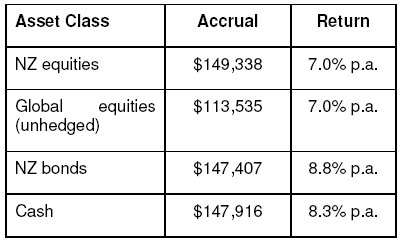
Again, return differentials bear no relation to the order in which the accrued values end up. Given the influence large negative returns have on depleting accrued values, you could be forgiven for assuming that cash’s steady always-positive returns offer a far better proposition. It does, but only in the final years before you actually need that accrued value. Over time, cash will usually not accrue as much as growth assets. For example, if our 20-year period was moved back nine months, cash and bonds give similar amounts as in the table above, whereas domestic shares provides result A. above, over $60,000 more. So, what is the moral of all this? One take-out is that negative returns are not the worst thing you can get in the early years of a regularly contributing investment (such as KiwiSaver for employees). In the same way that people who fill up their car with petrol once a week are now rejoicing that petrol prices are falling (hence each dollar buys more petrol), a regular contribution into a falling investment buys more units of the particular PIE you are investing in. As long as you don’t need that nest egg in the near future, then there is plenty of time for the investment to grow in the future. In the same way, do not be dismayed if your particular KiwiSaver fund has not performed as well as others in the various performance surveys that will undoubtedly come out over the next few months. As shown earlier, the actual investment returns earned over a period of time may not have particular relevance to the total dollar outcome you will receive at the end of a regular investment schedule. Finally, if you do need a lump sum at any stage in the near future, whether for retirement, emigration, house purchase, whatever, it then becomes relatively important to move it towards less volatile assets as that date approaches. Incurring a large negative return just prior to needing this money can leave you with a lot less than you expected, with no time to recover this. Peter Lynn, CFA, Head of Strategy To see this month Market Review numbers click here
Click the button below to subscribe and will have free unlimited access for a limited time to full article and all other articles on the site.
You will also be able to comment on articles on Good Returns.



![[The Wrap] What the heck is happening at the FMA?](https://goodreturns.publit.io/file/c_fill,w_300,h_200/a6c3bc06-6401-44de-96e2-286c090e132d.jpg)