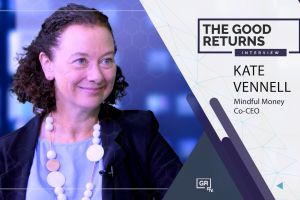



GRTV Transcript: Mindful Money co-CEO Kate Vennell on ethical investing
Welcome to Good Returns TV. I'm Philip Macalister.
GRTV: Joining me in the studio today from Mindful Money is the Co-chief Executive, Kate Vennell. Kate, nice to have you here.
We had Barry last here, I think, so it's nice to have you today.
Kate: Yeah. Great to be here, Phil. Thank you. I'm a great admirer of Good Returns, so I'm really excited to be here.
GRTV: Oh, thank you so much. And I was really excited to have you in here because Mindful Money have just done their most recent ethical investing awards in their conference. How did that go?
Kate: It went really well. It was a great event. We had two new awards.
GRTV: Now, I was just going to ask you about that. What were those?
Kate: Those two new awards reflect a trend that we're seeing for more retail funds to be investing in positive outcomes and impact investing. So the first one was really on that theme. It was for best positive outcomes integration.
We had a number of managers apply for that and Pathfinder won it due to the depth of the work that they do in thinking about positive outcomes themes, including having a dedicated committee for it and investment in things like Wool Aid that they've done recently. They've added an allocation to Motion Capital venture capital fund.
So they're really committed to not only avoiding harm, but also investing in good stuff.
Generate were highly commended, and I think that's a tribute to the pioneering work they have done with investing in community housing bonds, as well as quite a large investment into Icehouse, which gives every Kiwi a little slice of a great New Zealand innovator.
So two great funds really leaning into helping Kiwis to have things that are good in their funds.
So that was really nice. That was a new award.
GRTV: And tell me- Yeah ... Pathfinder took out the top award again. What does this mean? Pathfinder wins it every time.
Does that mean that they're just so far ahead of everyone else, or does it mean that maybe some of the other managers just aren't doing enough in the ethical investing space?
Kate: That's a loaded question. I think Pathfinder are very good at what they do, and they continue to think and reflect, including on some of the really difficult questions that we've had emerging in the last couple of years, including on war and conflict, as well as leaning into the positive outcomes.
So, they are a very good operation. They put ethical investing as what they do. It's all they do.
So, it gives them that ability to really focus on it, and that probably is reflected in why they keep winning.
I think Jesse Mulligan (MC) called them the Meryl Streep because Streep's always up for Best Actress!
But we have other great funds in New Zealand. And I see increasingly I'm heartened to when I talk to responsible analysts at a number of the funds, at how committed and thoughtful they are.
I think it is harder if you're a fund manager and you're running what you could call traditional funds as well as sort of deeper green funds.
We do have a range of good options in New Zealand.
Yes, I'd probably like to see a bit more heft behind it all, and a bit more competition for the likes of Pathfinder and Generate and others who are up there.
GRTV: The other thing which was interesting, and we've often had the same financial advisers coming up the finalists. That sort of changed a little bit this year.
So, tell me, what do you think that means?
Kate: I think it means a couple of things. I think it's reflective of a slightly new generation emerging in financial advice, and well, I will say this, some of them are women.
And what I really like about the new generation, and it partly links to the evolution of advice here in New Zealand with the code, a real commitment to lifelong learning, a real commitment to doing what is best for the client.
So yeah, we had two people who were finalists apart from the great examples of Carey Church and Rodger Spiller.
We had Melanie Clark, who's just joined Ethical Investing.
We had Melissa Allen, who's done a really considered piece of work with her firm Milestone to embed responsible investing.
I think they're both personally interested. Additionally, I believe they're responding to client demand. So, we know that three-quarters of Kiwis want responsible investing.
What we also know is 81% of women want responsible investing, and our surveys keep showing these results.
GRTV: So it's a bit of a niche for women advisers to play in?
Kate: I think it's less than a niche. When you've got three-quarters of people wanting responsible investment, to me, it's actually an untapped demand that's huge.
I think many advisers maybe have thought, "I can manage my client." This is perhaps being unfair.
"I can manage my client. I can give them this offer.
We don't need to go into that territory.
Or if we do, we'll do it in a very light way." And I think increasingly, clients are getting more demanding.
GRTV: It's interesting too because we did a piece of work last year, which asked what sort of funds like ethical advisers use? A lot of those funds will be funds that advisers who don't specialise in ethical investing would use.
So, it's not actually that hard to build a portfolio, I would've thought.
Kate: It's not. There's lots of advice now that you can get to if you own an advice firm.
Great outfits who can help you structure portfolios.
GRTV: Mindful Money?
Kate: And Mindful Money, yeah. I'll give a plug for Mindful Money.
There are also training that people can do. There's a good one that RIIA are offering on ethical advice.
There's lots of resources for advisers, and I think a good advice firm can have a range of options. Almost every fund now in New Zealand has some responsible investing.
It might be exclusions, but you should have a deep ethical offer because if you're not, I feel you may be failing your clients. And to me, it's embedded in the code of advice that your advice needs to be suitable for the client.
That means it needs to have some alignment with their values.
GRTV: But you talked about that that there's an obligation under the code. More advisers should be embracing ethical investing but they're not. How do you think that's going to play out?
Kate: Well, I think we've got a gap. I think we've got a different type of advice gap.
I feel that as the money flows, this big inheritance wave that we are told is coming the next generations are going to be quite a lot more assertive.
Kate: And I feel this for my generation, Gen X women, we have a bit of a stereotype about sometimes being assertive and demanding and expecting more, and I think more advisers are going to find themselves sitting with assertive Gen X people who want a bit more. And if they don't get that, the risk of keeping that client, especially if that client has come to them through inheritance, rises. I think that's also something that all advisers are thinking about at the moment.
GRTV: One of the things we've observed is since we went into this new financial advice regime three and a bit years ago, the industry's changed quite significantly.
A lot of the older advisers have left, and we have younger advisers coming into the market. Do you think that's going to shift the dial with how advisers embrace ethical investing?
Kate: I think it is, and I think I'm seeing evidence of that with those new entrants to our awards, that it is shifting the dial, and it's shifting the dial also on a whole lot of other stuff, too. I think the competency of advisers just continues to rise.
We're seeing much more commitment to continuous learning. We're seeing a real understanding of the other behavioral elements around your client. They haven't just come looking for the solution. They've come with a whole set of life questions.
They may have had a big life event like a divorce. They've come into money.
They've sold a business. That, and especially in the age of AI, to keep a client, it's about really understanding that client. So that's my view about advice.
GRTV: And so just to sum that up, we're getting into a much better space for ethical investing?
Kate: Yeah.
GRTV: Is that how you'd sum it up?
Kate: I think so, and I think the other thing that excites me, which was the other part of our awards, is more people want to do good, and do good through their investments.
We're seeing the large owners of assets, the big trusts, the philanthropic foundations, wanting to think about how they invest in line with their mission. So one of our other new awards was for best ethical asset owner or investor, and we had two great exemplars.
We had Bay Trust, who won the award.
They have done a lot to put their funds into community housing in the Bay of Plenty, working with partners, investing into Purpose Capital.
We also had Claire Foundation, which is a very large philanthropic foundation, and they have impact at the centre of their whole portfolio approach for how they're investing their money.
And I think this says to me there's a new breed of really strategic thinking about doing good for our communities.
It's not just about providing grants anymore. It's about how can we leverage the funds that we steward. It's something deeper now.
It's something deeper, and I think that's another place where advisers are going to be coming with more clients who want to do intentional philanthropy, have family trusts, or whatever, and are looking for that support.
GRTV: Thank you, Kate. We'll wrap it up there. Congratulations to Mindful Money and the team for a successful awards and conference.
This transcript has been edited for clarity and readability.

![[The Wrap] What the heck is happening at the FMA?](https://goodreturns.publit.io/file/c_fill,w_300,h_200/a6c3bc06-6401-44de-96e2-286c090e132d.jpg)
![[GRTV] Increasing access to advice](https://goodreturns.publit.io/file/c_fill,w_300,h_200/cbc35b09-7a76-4aa2-b2cf-f40bed493819.jpg)
![[GRTV] FMA provides North Star to financial advisers](https://goodreturns.publit.io/file/c_fill,w_300,h_200/00a635b7-9903-4b2f-bb3a-656352726ced.jpg)