



The latest changes at Fidelity Life
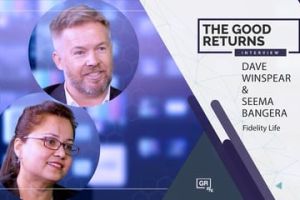
GRTV: Welcome to Good Returns TV. I'm Philip Macalister. Joining me in the studio today, I have two guests from Fidelity Life. I have Dave Winspear, who is the chief commercial officer, and also joining us on the couch today is Seema Bangera, who is the chief claims and operations officer. How did I go on that?
Dave: Perfect.
GRTV: Now, so tell me, we'll start with you, Dave. There's been a few changes at Fidelity Life recently. Can you sort of talk us through those and what your roles are now?
Dave: There certainly have been. There have been two main changes. The first is, as you said, that I've stepped into the chief commercial officer role, and that was in response to Bronwyn Kirwan, who you know very well, moving on to an exciting new opportunity and market. So my role's changing from leading operations into leading commercial. So that's the first change. The second change is that Seema's role has expanded from chief claims officer to now include operations as chief claims and operations officer. And I have to say, Seema and I are both really excited about this change.
GRTV: And you've had quite a lot of experience in this area. Can you talk me a little bit through what you've done there?
Dave: So what people might not know about me, Phil, is that I've actually been in the life insurance game for 20 years, and while I ran operations more recently for just under 18 months, the vast majority of those 20 years across Australia and New Zealand has been in commercial-related roles, so strategic partnering, growth, leading distribution, new ventures. So it's almost like I feel like I'm coming home. And I kind of started in commercial at Fidelity. Bronwyn was the one that brought me over, and I ended up leading distribution for a period of time, building really strong relationships in market, which I'm looking forward to reigniting.
GRTV: And can you tell me how your role's changed a little bit, Seema?
Seema: So, my role initially was spanning across claims, and now it includes operations as well. So, what that means is right from onboarding a customer, underwriting, through to service, operations, retention, and claims. So the end-to-end customer value chain is now under one leadership.
GRTV: So that makes sense, and you can see everything from start to finish, basically.
Seema: Oh, 100%. I firmly believe that a customer's claims journey doesn't begin when a claim is lodged. It actually begins right at the point of application and underwriting. And having the right leaders in the right room making the decisions where it matters is really important. And this role enables that.
GRTV: And in practice, what does it mean for advisers and customers, your expanded role?
Seema: Look, Phil, we know that for customers, they value clarity, transparency, speed, accuracy, and a responsive insurer who's got their back. And our focus really in bringing these functions together is to ensure that we have seamless experiences, stronger decision-making, less handoffs, and really making sure that in the key moments we deliver to the adviser's promise.
GRTV: Do you have any examples about stuff you're doing in that area you can talk about?
Seema: Yes, we are. We are looking at various parts of the business where we have handoffs and making sure that work goes to the right place first time. We are focusing on one-touch processes, so that way when work goes to the right place, to the right people who are equipped to take it to the best possible outcome for the customer and the adviser. We're also investing in a lot of retention tools, because with the cost of living pressures, it is really important that we as an industry focus on being proactive to this challenge and make sure that customers have the right options at the right time, and also the advisers have tools and education and training around that.
GRTV: So the cost of living issue is still quite a big issue for you guys as life insurers?
Seema: I think across the industry, we are no different. The shared wallet is really strained, and customers are having to make difficult choices. What's important is that customers make informed choices backed by good advice. They understand the value of their cover, and they understand the implications of moving cover or cancelling it.
GRTV: What tools and resources does Fidelity Life have to help in this area?
Seema: One of the aspects really important to us is that whatever tools we deliver are practical and can be used in real time, and they're meaningful. So for customers, we have created hardship packages wherein we can provide premium relief for vulnerable customers. And also, if there are severe weather events, we can roll out premium relief instantly so that we can have solutions in moments that matter. For advisers, we are looking at practical tools in terms of education. We've had a Protect and Value masterclass that was attended by over 400 advisers, and they were able to gain from it to have better retention conversations with customers. We've also had behavioural economic training, that's a mouthful, to help advisers in their interactions with customers. And also, we've been doing a lot of thinking on how we serve up the right information to advisers at the right time to enable these retention conversations. So it's like an always-on strategy, and we are constantly developing it to ensure that we show up in market when required.
GRTV: And Dave?
Dave: I think the other thing is that we have quite a large team that's focused on supporting customers and advisers day to day when it comes to affordability. So there are about 13 people now dedicated to either speaking with customers or advisers during that journey, and they have these tools at their disposal to be able to support customers. So that's been very effective.
GRTV: And you talked about things being simpler and faster for advisers. What are you doing in that sort of space?
Dave: Look, I think one of the things that really makes Fidelity different is that we're locally owned and we're very focused. So that means that we can respond to the market quickly. And I think that's one of our propositions, is being able to listen and act quickly. So, particular areas where we're focused on trying to be faster and simpler is very much around use of live chat, particularly for underwriting, the design of our e-app, that has had very strong user experience design, and we've received constant feedback that it's quite simple to use. So, there's a range of tools to make things simpler and faster.
GRTV: And Fidelity Life's just come to the end of its financial year. How is the company going? I don't know what you can give me in terms of numbers, but...
Dave: Well, that's right. We only just finished our financial year at the end of June, so we can't share too much, particularly as we're finalising year-end, but we can share a couple of anecdotes. One is that Fidelity's delivered the strongest customer experiences on record. So that's a customer experience measure across multiple touchpoints. Fidelity's never delivered experiences like this before.
GRTV: Wow.
Dave: That's also the same with adviser experience. So both of these experiences are at record highs. Our financial performance is also incredibly strong, and our new business volumes, particularly through the adviser channel, are the highest they've been in a long time.
GRTV: Really?
Dave: So we're very proud of that.
GRTV: Oh, that's excellent. And what do you think has driven a lot of that?
Dave: I think it's driven by a couple of things. Fidelity is really focused on trying to grow through the adviser channel. So we've invested considerable resources in making sure that we are able to uplift products, price, underwriting, and our tools. But I actually think one of the major drivers is our people. Now we've been able to deliver those experiences not through a lot of investment in automation or additional resources. We've driven it through building a culture that really focuses on customers and advisers, so we're particularly proud of that.
GRTV: Very big focus. And recently, the Engage Conference was postponed. Can you give us any update on where that's at?
Dave: Look, it's really unfortunate that we had to postpone that, and we still believe it was the right decision at the time. And we're closely monitoring the situation globally to try and determine when is the right time to hold Engage. And as you know, there's a lot of uncertainty in market at the moment. It just makes it really hard to confirm that date right now. But what we are doing in place of Engage is making sure that we're investing in engagement across the industry. So that includes local events, our adviser development programs, which create a lot of moments to create connection. So it's still a focus, even if Engage doesn't have a set date right now.
GRTV: It's interesting times out there at the moment.
Dave: It certainly is. You never quite know each day what's happening.
GRTV: And of course, no conversation could ignore AI. How are you guys using AI in the business?
Dave: Absolutely. Seema will touch on the operational use in a moment, but there's a couple of areas that I'd like to talk about. One is that we've used AI creatively. I'm sure you've attended Engage on Tour last year. Fidelity made a video, a movie actually, which included me abseiling out the side of a building. That obviously used AI quite extensively, and it was a lot of fun, but also showed that Fidelity's forward-thinking in how we use that capability. The other area is internally. We're equipping staff to be able to use AI in their day to day. So most staff have access to Copilot, and they're encouraged to use that quite actively within some guidelines. There's one other area. It's not that we're using AI, but we've developed this tool that actually helps advisers benchmark their digital maturity, and it was developed in collaboration with the Melbourne Business School. And that includes a range of questions around use of AI. So we're currently gathering data at the moment, but really excited to be able to benchmark how advisers are using AI and how that will evolve over time.
GRTV: That'd be very interesting. And Seema?
Seema: Fidelity's approach to AI has very much been about education, governance, and structured use cases in collaboration with the frontline teams. We want to make sure that whatever we deliver meets the business outcomes and make sure that we have the efficiency and productivity and simplification that AI has to deliver. Now, one of the aspects that is really important to us is that any efficiency out of AI is reinvested back in the business, and we are able to invest those resources in ensuring that our customer and adviser experiences are great. This is really important. It is not just about cost out, it is about reinvesting back. And some of the examples of AI are underwriting automation, and triaging new claims, how we manage our long-term claim book, call QA. All of these are various spaces where AI has really helped us. Just on a final note, as I said, AI creates a lot of efficiencies, but what's important is that we still maintain the human touch and empathy and accountability that comes with a life insurance business.
GRTV: Very important. And just to wrap up, you've both been in life insurance for a long time, as you mentioned at the start. Do you want to give me a little snapshot of how things have changed and where you see life insurance now?
Dave: Look, there's been a lot of changes. We were talking about that earlier actually, just before the interview. So, obviously regulation to protect consumers has been a huge change, and I've seen that play out quite differently in the Australian market and the New Zealand market. So I'm really glad at how the New Zealand regulators are responding. I think it's making sure that advice is accessible, which I think is a bit different to how that's played out in Australia. So regulation, digitisation, in terms of customer experience, but also adviser businesses. There has been consolidation, as we've seen in the industry, not only with providers, but also advice practices that we were talking about earlier. So there've been some really quite material changes. I think some of those will continue. With regulation, for example, I'm expecting that the regulator will start to gain more clarity around what good looks like, so that moving from frameworks into guidelines. But look, I think that's good for consumers and it's good for the industry.
GRTV: Excellent. And Seema?
Seema: Well, I've been in the industry for 24 years, and one of the biggest changes for me is that insurance, life insurance in particular, is no longer a set-and-forget product. It's no longer a legacy business. Customers are expecting more of us. They want more transparency, clarity, interact with their policy sooner than claims. Digital interactions become the norm. Which is very exciting because it means that we get to innovate and deliver to those expectations. Dave's already touched on the regulatory landscape, and automation, digitisation. And to finally answer your last piece of the question, what next? I think connected experiences will be really important. Ease of doing business, transparency, and confidence.
GRTV: Great answer. Thank you very much for your time, both of you, for coming in, and it's been really interesting.
This transcipt has been edited for clarity and readability.

![[The Wrap] What the heck is happening at the FMA?](https://goodreturns.publit.io/file/c_fill,w_300,h_200/a6c3bc06-6401-44de-96e2-286c090e132d.jpg)
![[GRTV] Increasing access to advice](https://goodreturns.publit.io/file/c_fill,w_300,h_200/cbc35b09-7a76-4aa2-b2cf-f40bed493819.jpg)
![[GRTV] FMA provides North Star to financial advisers](https://goodreturns.publit.io/file/c_fill,w_300,h_200/00a635b7-9903-4b2f-bb3a-656352726ced.jpg)